
How to Maintain Industrial Chains?
Industrial chains operate under heavy loads in conveyor systems, lifting equipment, power transmission mechanisms, mining facilities, and heavy-industry applications. Continuous movement, friction, dust, moisture, high temperatures, and abrasive materials can adversely affect chain performance over time.
Regular industrial chain maintenance helps prevent unplanned downtime, extend equipment life, and maintain operational safety. However, maintenance is not limited to lubricating the chain. Cleaning, visual inspection, measurement, alignment checks, and the inspection of connection equipment are also essential parts of the process.
Why Is Industrial Chain Maintenance Important?
Friction and wear may increase when chain maintenance is neglected. This can cause chain elongation, damaged links, weakened connection points, and inefficient system operation.
The main benefits of regular maintenance include:
-
Helping extend the chain’s service life
-
Reducing unplanned production downtime
-
Enabling early detection of wear
-
Helping prevent energy losses
-
Protecting sprockets and connection equipment
-
Supporting operational safety
-
Potentially reducing maintenance and replacement costs
If a minor chain problem is not detected in time, it may damage sprockets, shafts, guides, and other system components.
How Often Should Chains Be Maintained?
There is no single maintenance interval suitable for every application. Maintenance frequency should be determined according to the chain’s application, working load, speed, and environmental conditions.
The following factors should be considered when preparing a maintenance schedule:
-
Daily operating time
-
Load applied to the chain
-
Operating speed
-
Concentration of dust and dirt
-
Exposure to moisture and water
-
Ambient temperature
-
Chemical or abrasive substances
-
Impact and vibration
-
Lubrication system
-
Manufacturer’s maintenance recommendations
More frequent inspections may be required in environments with high levels of contamination and wear, such as mining, cement, recycling, and agricultural applications.
Essential Steps in Industrial Chain Maintenance
1. Shut Down the System Safely
Before maintenance begins, the system must be completely shut down and secured against unexpected start-up. Energy sources must be isolated, and the facility’s safety procedures must be followed.
The chain must not be under load, particularly in lifting systems. Maintenance work should only be performed by authorised and properly trained personnel.
2. Clean the Chain
Dust, mud, metal particles, and old lubricant residue accumulated on the chain can accelerate wear. These contaminants can also make cracks and deformation more difficult to identify during a visual inspection.
The cleaning method must be suitable for the chain material and coating and comply with the manufacturer’s instructions. Chemicals that could damage the chain or its existing surface coating must not be used.
After cleaning, the chain should be thoroughly inspected and, where necessary, correctly relubricated.
3. Perform a Visual Inspection
During each maintenance procedure, all accessible sections of the chain should be examined carefully. The inspection should not be limited to only a few links.
Look for the following signs:
-
Cracks
-
Bent or twisted links
-
Severe corrosion
-
Surface pitting
-
Impact marks
-
Reduction in link diameter
-
Loose connection points
-
Uneven wear
-
Heat-related discolouration
-
Damage in welded areas
-
Missing or damaged connection components
A chain showing suspicious signs should not remain in service without a technical assessment.
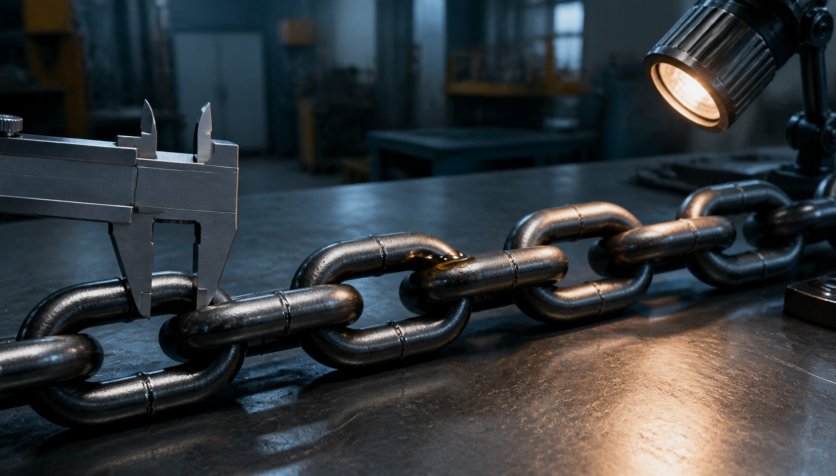
4. Measure Chain Elongation
Pitch elongation can occur as link surfaces wear during operation. This condition is commonly referred to as “chain elongation.”
When taking measurements, the total length across a specified number of links should be checked and compared with the dimensions of a new chain or the limits permitted by the manufacturer. Measuring a single link may not always provide an accurate result.
Permissible wear or elongation limits vary depending on the chain type and application. Assessments should be based on the manufacturer’s technical data.
5. Lubricate the Chain Correctly
Correct lubrication is critical to chain maintenance. It is not sufficient for lubricant to remain only on the chain’s outer surface. It must reach the contact points between the links, where movement and friction occur.
The following factors should be considered when selecting a lubricant:
-
Operating temperature
-
Chain speed
-
Load level
-
Amount of dust and dirt
-
Exposure to moisture and water
-
Requirements of food-processing or chemical facilities
-
Manufacturer’s recommendations
Using excessive lubricant is not always beneficial. Too much lubricant can cause dust and abrasive particles to adhere to the chain.
Certain chain types and specialised applications may require different maintenance methods. Lubrication must always be performed in accordance with the manufacturer’s instructions.
6. Check Chain Tension
Chains operating with insufficient or excessive tension may experience uneven wear and reduced system performance.
Excessive tension may:
-
Increase the load on the chain and sprockets
-
Place excessive stress on bearings and shafts
-
Cause premature chain wear
Insufficient tension may:
-
Cause the chain to disengage from the sprocket
-
Increase impact loads
-
Create irregular movement
-
Damage guides and guards
The correct tension should be set according to the system design and the manufacturer’s instructions.
7. Check Alignment and Sprockets
A misaligned chain can cause uneven wear on the links and sprockets. Sprockets, shafts, and guides should therefore be inspected together with the chain.
Look for the following signs during a sprocket inspection:
-
Worn or thinned teeth
-
Broken teeth
-
Uneven surface wear
-
The chain not seating correctly on the sprocket
-
Misalignment between sprockets
-
Unusual vibration or noise
Using a new chain with severely worn sprockets can significantly shorten the chain’s service life.
8. Inspect Connection Equipment
Hooks, shackles, master links, and other connection equipment used with the chain should be included in the same maintenance schedule.
Connection components should be checked for cracks, deformation, looseness, corrosion, and the legibility of their capacity markings. Even if the chain appears to be in good condition, damaged connection equipment can compromise system safety.
Main Causes of Chain Wear
The principal factors that may cause premature wear in industrial chains include:
-
Insufficient or incorrect lubrication
-
Overloading
-
Incorrect chain selection
-
Chain and sprocket misalignment
-
Excessive tension
-
High levels of dust and dirt
-
Corrosive environmental conditions
-
High temperatures
-
Impact loads
-
Worn sprockets
-
Incorrect installation
-
Irregular maintenance
Replacing only the damaged chain may not be sufficient to resolve the problem. The underlying system issue causing premature wear must also be identified.
How Can You Tell When a Chain Needs to Be Replaced?
If any of the following conditions are identified, the chain should be removed from service and assessed by an authorised specialist:
-
Cracked or broken links
-
Significant deformation
-
Elongation exceeding the permitted limit
-
Substantial reduction in link diameter
-
Severe corrosion
-
Deep surface damage
-
Suspected structural changes caused by heat
-
Evidence of improper repairs or welding
-
Excessive wear in connection areas
-
Loss of product identification markings
Particularly with lifting chains, attempting to repair a damaged area with unauthorised welding or joining chain sections with incompatible components can create a serious safety risk.
Recommendations for Extending Chain Service Life
-
Use a chain type suitable for the application.
-
Do not load the chain beyond its rated capacity.
-
Establish a regular inspection and maintenance schedule.
-
Use the correct lubricant in the appropriate quantity.
-
Keep the chain clean and correctly tensioned.
-
Check the alignment of sprockets and guides.
-
Select materials and coatings suitable for the corrosion risk.
-
Replace damaged connection components without delay.
-
Record all maintenance activities and measurements.
-
Follow the manufacturer’s technical instructions.
Maintenance records can help monitor the rate of wear and determine the estimated replacement time more accurately.
Nodal Arch Industrial Chain Solutions
Nodal Arch provides chain and connection solutions for the mining, maritime, cement, chemical, recycling, agricultural, construction, and heavy-industry sectors.
Standard or custom-manufactured product options can be determined by evaluating the application’s working load, environmental conditions, dimensions, and technical requirements.
Our range of solutions includes:
-
Industrial chains
-
Conveyor and mining chains
-
Grade 80 and Grade 100 lifting chains
-
Stainless steel and galvanised chains
-
Maritime and buoy chains
-
Hooks, eye bolts, shackles, and master links
-
Steel wire rope systems
-
Custom-sized chains
-
Special alloy and coating options
-
Technical assessment and engineering support
Contact Nodal Arch for industrial chain selection, replacement, or project-specific product requirements.
Frequently Asked Questions
How Often Should an Industrial Chain Be Lubricated?
The lubrication interval varies according to the working load, speed, temperature, and environmental conditions. The appropriate interval should be determined in accordance with the manufacturer’s instructions and the facility’s maintenance schedule.
Can a Rusted Chain Remain in Service?
Not every type of surface discolouration presents the same level of risk. However, a chain showing severe corrosion, pitting, or loss of cross-sectional area should not remain in service without an expert assessment.
How Is Chain Elongation Measured?
The total length across a specified number of links is measured and compared with the dimensions of a new chain or the limits established by the manufacturer. The measurement method may vary depending on the type of chain.
Can a New Link Be Added to an Existing Chain?
Adding a different or new component to an existing chain without assessing compatibility and safety is not recommended. Only approved components and suitable joining methods should be used, particularly in lifting applications.
Should the Chain and Sprockets Be Replaced Together?
A worn sprocket can quickly damage a new chain. Both the chain and sprockets should therefore be inspected before a replacement decision is made.